Sport · 7 min read
From slings to rackets
Spain does not only train good tennis players: it carries an ancestral gesture. From the Balearic sling to the forehand drive, the distance is shorter than it looks.
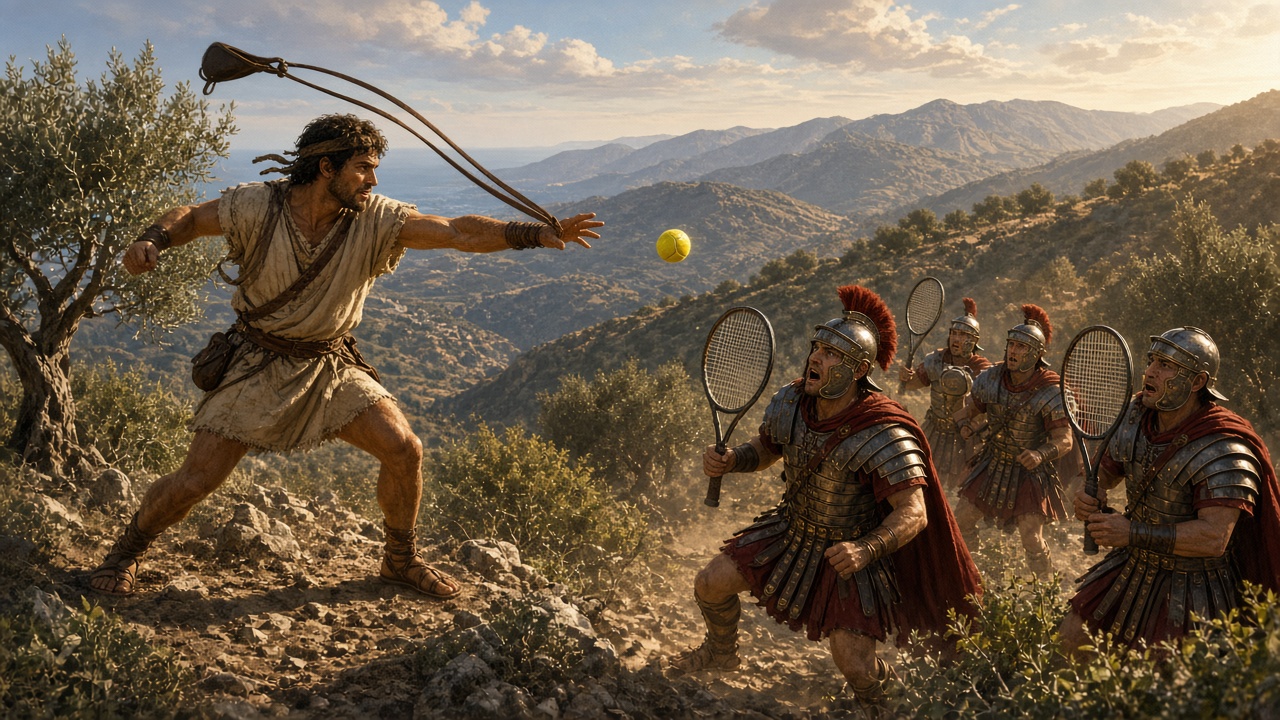
I have been thinking for a while about why Spain produces so many strong tennis players. It is not a passing impression: for years we have watched players emerge with very clean strokes, especially from the Balearic Islands, Valencia, Murcia and also Catalonia. Names like Carlos Moyá, Rafa Nadal or Carlos Alcaraz do not feel like isolated accidents.
There is a logical, familiar explanation. Spain is a hot country with little natural grass for British-style competition, and tennis has long been played outdoors on clay. That is why Spanish dominance has been clearest on that surface, even if hard-court tennis indoors has improved a lot in recent years. On grass the potential exists, but Spanish tennis culture was born in the red dust.
Training matters too. There was — and still is — a solid network of academies. Padel is growing fast now and taking space from tennis, yet that does not erase the fact: Spain’s level is not explained by good schools alone. Quality coaching exists in many countries. Spain, meanwhile, has had a spectacular share of players high in the rankings. Aside from giants like Federer or Djokovic, many Spaniards have stood near the top alongside Nadal.
That raises another question. Why do so many great arms come from the same strip — Mallorca, Valencia, Murcia — even where good schools exist? I think there is something else. A factor people have already mentioned: a genetic and cultural inheritance of the gesture.
Before the Roman Empire, Hannibal’s Carthaginian forces hired Balearic mercenaries famous for the sling. Balearic slingers were specialists: a strong, explosive arm able to whirl the weapon and hurl projectiles like bullets. They had a base in Cartagena and Murcia and moved along the Levante coast. Armies hired them because that throw decided battles.
That motion looks a lot like a forehand drive. The sling turns above the head; the drive is more lateral. But the arm logic — rotation, timing, whip — feels familiar. Throwing with a sling is, in a way, hitting a drive. So it seems plausible that in the genetic and cultural memory of the Levante and the Balearics a gesture remained, waiting for tennis to find it again.
I have no lab proof. I do not have many doubts either: when I see that Spanish swing, I can still hear an ancient sling whistling.
1 likes · 1 shares